
“Which adhesive is the best?” is one of the questions we hear most often. The honest answer: there is no best lash adhesive. There is the adhesive that suits your pace, your experience and your clients. A very fast adhesive can noticeably speed up your workflow in confident hands – and be the reason for weak retention in unsure hands.
In this article you will learn what the setting time means for your work, how to assess your own pace honestly, how to recognise that adhesive and hand don't match, and how to test a switch properly.
What the setting time means for your work
The setting time is the window in which you can still position the extension on the natural lash. After that it is fixed. With an adhesive that sets in about one second, you have noticeably more time to align than with one that sets in about 0.3 seconds.
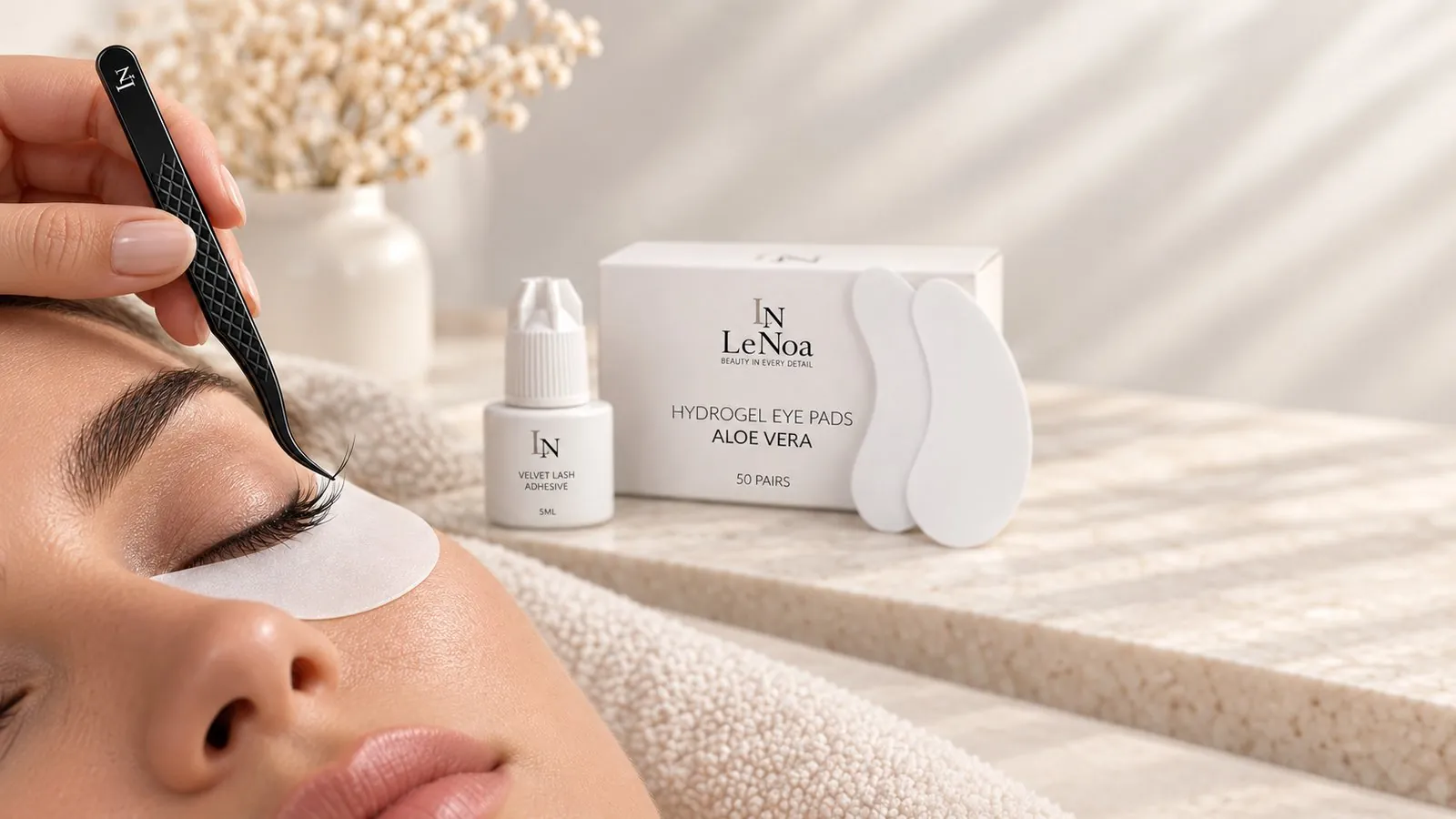
Shorter is not automatically better. A fast adhesive only makes you faster if your hand places the extension in the right spot without hesitation. If you still correct afterwards, you are working against the clock with a fast adhesive rather than with it.
On top of that, the setting time affects not only your pace but also the quality of every single bond. An extension needs a clean contact surface with the natural lash. If the adhesive sets while you are still aligning, you get a bond that looks finished but is less resilient. Choosing an adhesive is therefore not a question of ambition but of fit. Many artists work with more than one adhesive over the years: the hand becomes more confident, the technique changes, and the clients in the studio differ. An adhesive that was a perfect fit two years ago does not have to be the right one today – and vice versa.
The four Le Noa adhesives at a glance
| Adhesive | Setting time (approx.) | Properties | Suits |
|---|---|---|---|
| Velvet Lash Adhesive | 1 sec. | controlled positioning, for classic and volume | beginners, advanced artists, volume technique |
| Sensitive Lash Adhesive | 0.5–1 sec. | latex-free, low-fume, the milder option in the range | artists who want a milder option, also in their first months |
| Pro Lash Adhesive | 0.3 sec. | latex-free, low-fume, for experienced artists | experienced artists with a confident hand |
| UV Lash Glue | cures under UV light | cures only under UV light, for the Le Noa UV Lash System | artists who want to control the curing themselves |
You will find all four adhesives in the Lash Adhesives category.
Velvet Lash Adhesive – approx. 1 second
The Velvet Lash Adhesive gives you time for clean positioning. It is suitable for classic and for the volume technique – especially when aligning fans, the slightly larger margin is pleasant.
Sensitive Lash Adhesive – approx. 0.5 to 1 second
The Sensitive Lash Adhesive is latex-free and low-fume and the milder option within our classic adhesive range. Individual reactions still cannot be ruled out, and it does not replace a consultation before the treatment. With its moderate setting time it also fits well into your first months.
Pro Lash Adhesive – approx. 0.3 seconds
The Pro Lash Adhesive is made for experienced artists whose hand places precisely without correcting. It is latex-free and low-fume.
UV Lash Glue – curing under UV light
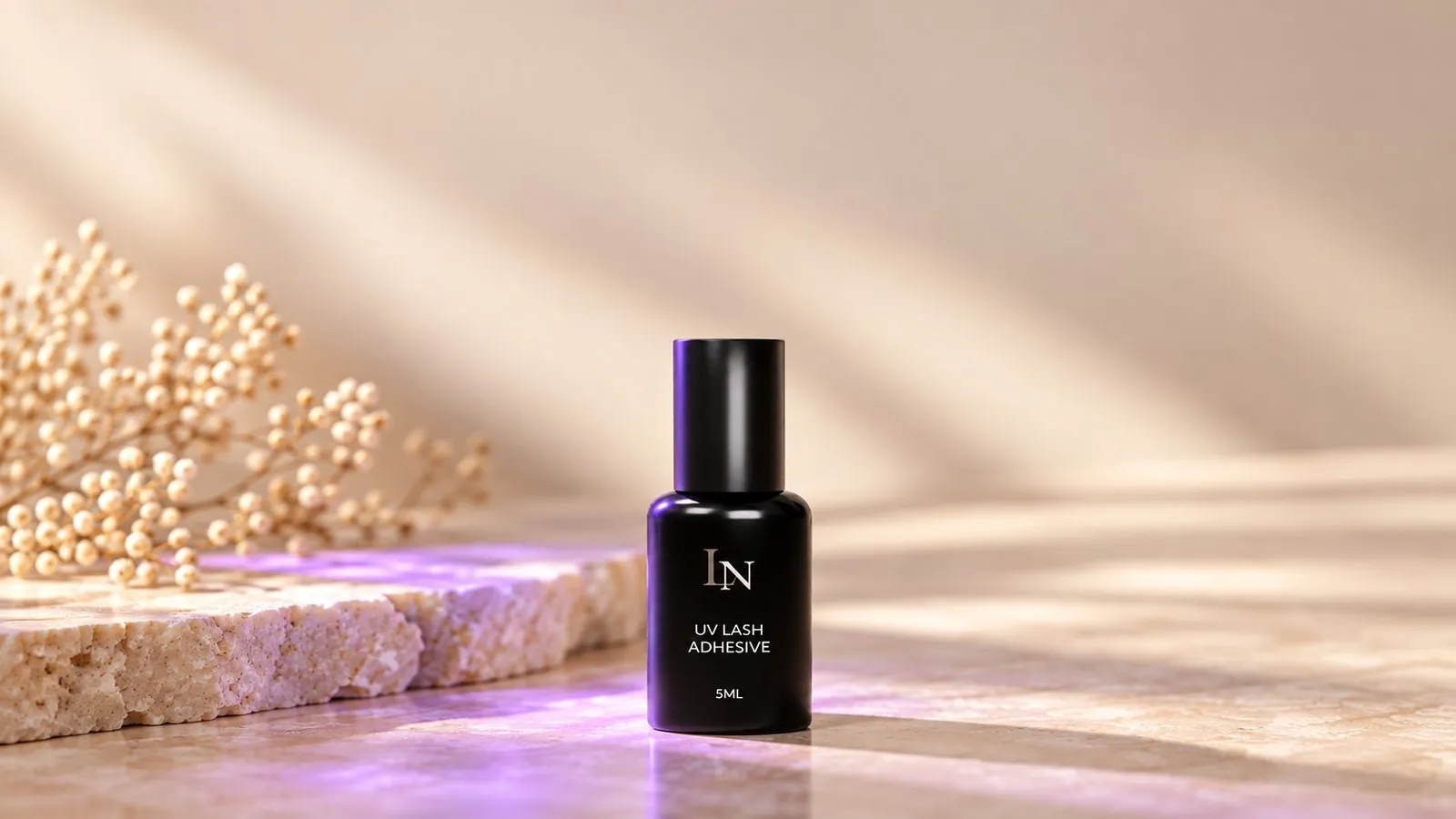
The UV Lash Glue cures exclusively under UV light. You position calmly and decide yourself when the bond is fixed. You use it with the Le Noa UV Lash System. You can read more in our article UV Lash Glue.
What is your real pace? A short self-test
People tend to overestimate their own speed, especially after the first successes. Answer these questions honestly, ideally after a completely normal treatment:
- Do you often correct the position of an extension after it has touched the natural lash?
- Do you mainly work classic or hand-made volume fans?
- Do you place each extension in one go, without hesitating?
- Do you have to separate many stickies at the end of the treatment?
- How long does a full set take you compared to six months ago?
If you often correct or separate many stickies, you need a larger time window.
“When I notice that an artist is still correcting after placing, a 0.3-second adhesive is usually still too fast.” – Samira
If every movement is precise and you notice that you are waiting for the adhesive, a faster adhesive may suit you.
Beginner
In the first months, precision comes before speed. An adhesive with a setting time of about one second or 0.5 to 1 second gives you room to isolate and position cleanly.
“Beginners start with Sensitive or Velvet in my classes. The Pro only comes once the hand is confident.” – Samira, Head Trainer of the Le Noa Academy
Advanced
You work confidently but still position volume fans deliberately. Velvet often remains the right choice here. Sensitive comes into play as well if you want a milder option for individual clients.
Experienced
Your hand is precise, corrections are rare and you noticeably wait for the adhesive to set. Then the Pro Lash Adhesive can speed up your workflow. Many experienced artists still keep a second adhesive in the studio – as a milder option for individual clients or for days when the room climate doesn't play along.
Still unsure after the self-test? The Adhesive Finder asks you four questions and gives you a clear recommendation.
Too fast or too slow? The symptoms
The adhesive is too fast for you if …
- the extension grabs before it sits cleanly on the natural lash,
- you can see extensions that only stick at one point or stand off slightly,
- small lumps of adhesive form on the tweezers or the fan,
- extensions fall out in the first days even though the preparation is right.
The adhesive is too slow for you if …
- extensions slip after placing or lean towards the neighbouring lash,
- you have to separate stickies more often,
- you use too much adhesive to “hold” the extension,
- you noticeably wait with every placement.
Room climate and storage change the setting time
The stated setting time applies under good conditions. Cyanoacrylate adhesives cure with humidity; 45 to 70 percent is optimal. If the air is drier, as is often the case during the heating season, the adhesive sets more slowly. If it is very humid, it grabs faster. The same adhesive can therefore feel different in October than in July.
Freshness plays a part too: renew the adhesive drop on the Glue Holder every 15 to 20 minutes and store the bottle upright, cool, dark and tightly closed.
“Store adhesive upright, cool and tightly closed, and take a new bottle after 4 to 6 weeks of being open.” – Samira
With the UV Lash Glue you control the curing yourself via the UV light.
If retention is still not right despite a suitable adhesive, the cause often lies elsewhere. Our article Lash adhesive not holding? Common causes of poor retention guides you through the diagnosis.
Switching and testing your adhesive properly
A new adhesive deserves a fair test. Here is how to go about it:
- Change only one thing. Keep your preparation with Lash Primer, extensions and routine the same so that you can really compare the adhesive.
- Note the room climate. Write down humidity and temperature for every test treatment.
- Start on a practice lash or strip first. Get a feel for the setting time before you work on a client.
- Start with familiar clients. Test on clients whose retention you know well and assess at the refill.
- Wait for several refills. A single appointment says little. Compare across several treatments.
- Keep the finish the same. If you use the Super Bonder , use it during the test as well.
Quick check: does your adhesive suit you?
- I rarely correct – otherwise choose a larger time window
- I don't noticeably wait for it to set – otherwise a faster adhesive may suit me
- Humidity is between 45 and 70 percent
- The adhesive drop is renewed every 15–20 minutes
- The bottle has been open for less than 4–6 weeks
- I have a milder option in the studio for individual clients
Frequently asked questions
Which lash adhesive is suitable for beginners?
Samira recommends Sensitive or Velvet for getting started. Both give you time to position. Use the Pro Lash Adhesive once your hand is confident.
Does a fast adhesive hold better?
Not automatically. What matters is that the setting time suits your pace and that preparation and room climate are right.
Which adhesive should I use for sensitive clients?
Within our classic adhesive range, the Sensitive Lash Adhesive is the milder option: latex-free and low-fume. Individual reactions still cannot be ruled out. A thorough consultation before every treatment remains important.
Does the UV Lash Glue work without a UV lamp?
No. The UV Lash Glue cures exclusively under UV light and is used with the Le Noa UV Lash System.
Why does my adhesive feel different in winter?
During the heating season, humidity often drops below 45 percent. The adhesive then sets more slowly. A hygrometer at your workstation shows you whether you should counteract.
Find your adhesive
Four questions, one clear recommendation: with the Adhesive Finder you find out which Le Noa lash glue suits your pace. And if retention still varies, the Retention checklist helps you narrow it down.
If you want to train speed and precision on real lashes, you will find the Basic and Volume Training of the Le Noa Academy on our training page.
About the author
Samira Kruckenhauser is Head Trainer of the Le Noa Academy and has more than 10 years of lash experience from real studio practice. She has worked with all four Le Noa adhesives and knows how much the setting time shapes the workflow.